Wednesday, February 16, 2011

Saturday, November 20, 2010
Animation and new model format.
I'm currently implementing a new format for 3D models.
This format will contains :
At the moment, I have written a MaxScript to generate models from 3dsMax. Only basics informations and keyframe animation are supported.
Here's a preview :


This format will contains :
- basics info : vertices, normals, texture coordinates and triangle indexes.
- Animation using keyframes or bones.
- Materials description
- Several models.
At the moment, I have written a MaxScript to generate models from 3dsMax. Only basics informations and keyframe animation are supported.
Here's a preview :


Wednesday, September 1, 2010
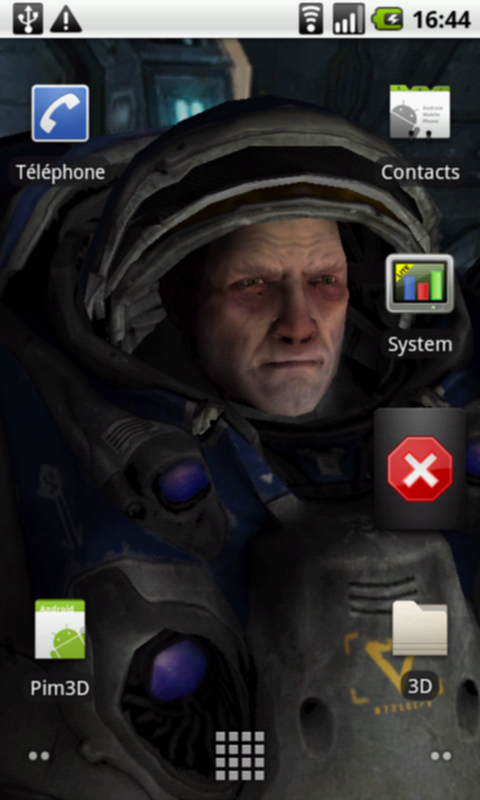
3D Live Wallpaper
I have implemented Materials and lights. Here a SC2 Space Marines as Live Wallpaper :)

Friday, July 23, 2010
Monday, June 7, 2010
Scene editor is functional !
The editor is functional. There are still some small improvements to do but here a sample :

And the result in application :


And the result in application :

Wednesday, March 31, 2010
Model Editor finished.
Now, models can be aggregated using the GroupModelEditor. This will allow to add and manipulate complex models into the scene.
Here the editor :

This editor allow to aggregate severals md2 models into one entitie.
Each "sub-model" have a field called type. This type can be associated to a custom object class derived from GLModelObject.
After that, each sub-model can be handled one by one.
Here an example :

NOTE : It's more efficient to move a static object with code than using Model animation. Static objects are loaded into VBO. If you rotate a VBO object, there is few datas sent into the bus. Whereas if animations are used, each vertices are sent at each render(only if modified), into the bus. On PC it's less important as buses (AGP or PCI-E) are very fast. But on mobile device, buses are slower.
In the near futur, I will make scriptable the above code, maybe with Lua. It will allows non-programmers to create a scene, and make it "alive!"
Here the editor :

This editor allow to aggregate severals md2 models into one entitie.
Each "sub-model" have a field called type. This type can be associated to a custom object class derived from GLModelObject.
After that, each sub-model can be handled one by one.
Here an example :

NOTE : It's more efficient to move a static object with code than using Model animation. Static objects are loaded into VBO. If you rotate a VBO object, there is few datas sent into the bus. Whereas if animations are used, each vertices are sent at each render(only if modified), into the bus. On PC it's less important as buses (AGP or PCI-E) are very fast. But on mobile device, buses are slower.
In the near futur, I will make scriptable the above code, maybe with Lua. It will allows non-programmers to create a scene, and make it "alive!"
Thursday, March 4, 2010
All effects
After added ground reflection :

All contacts are loaded from Android phonebook. The thumbnails comes from phonebook too.
Subscribe to:
Posts (Atom)